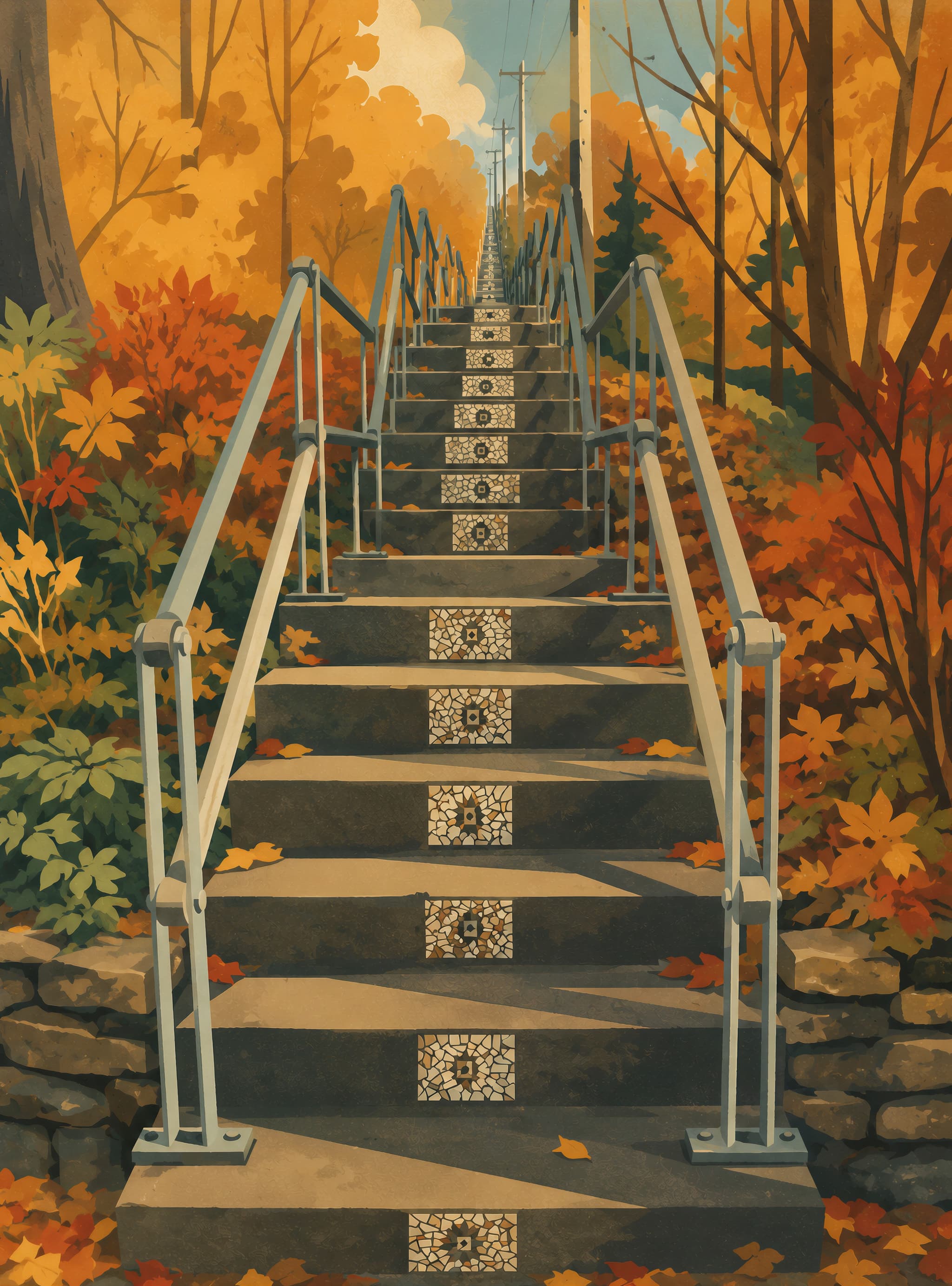

Cincinnati's public stairways, mapped and ready to climb.
Find stairs near you, see the climb before you go, and collect them as you explore the city's hillsides.
- public stairways
- 294
- public stairways
- neighborhoods
- 41
- neighborhoods
- feet of climbing
- 6,445
- feet of climbing
The City of Seven Hills
In June 1853, a writer for the West American Review named Cincinnati's defining feature: the seven hills that arc above the Ohio River, forming a crescent above the basin the way Rome's hills rose from the Tiber. The comparison was intentional. Both cities grew from river valleys on terrain no street grid could tame.
Charles Dickens, visiting eleven years earlier, described the city as lying in "an amphitheatre of hills" — one of the few American cities that earned his admiration.
Life on the Hills
Where there's hills, there's stairs. For over a century, Cincinnati maintained more than 400 public rights-of-way: concrete and stone steps tucked between houses, cutting through hillsides, dropping down bluffs from neighborhoods like Price Hill, Mount Adams, and Fairmount.
Before the stairs, there were inclines. Five inclined-plane railways were built between 1872 and the turn of the century to haul passengers straight up from the Basin below. They closed one by one. In the 1940s, WPA crews poured concrete steps into some of the same corridors the inclines had occupied, trading one hillside technology for a simpler, more enduring one.
Spring in Our Steps
Spring in Our Steps is a Cincinnati-based advocacy organization dedicated to the preservation, repair, and celebration of these public stairways. They've spent years surveying every staircase, compiling it all into a publicly available dataset. They organize walks, advocate for repairs with the city, and publish their data openly so others can build on it. Their work is the foundation this project's built on.